The Door Handle as a Small Instruction
A door handle signals how to open a door before you read a sign. Learn how shape and placement guide action, where cues fail, and what to choose.
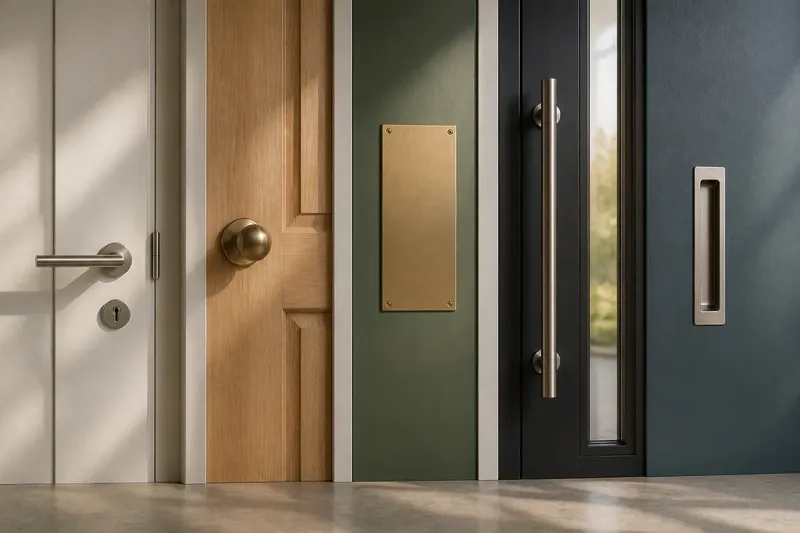
Which way should you move your hand when you reach a door? A door handle often answers before a sign can: a lever invites a press or pull, while a round knob suggests a turn. That small instruction is a design cue, not a command. Its clarity depends on the handle’s shape, position, the door’s movement and what a person can see or feel as they approach.
Designers call the action a form seems to invite an affordance. A lever affords pressing down; a projecting bar affords grasping. The cue works best when the action it suggests matches the door. When it does not, people may hesitate, try the wrong movement or look for a sign. Comparing handle types helps show what each communicates and where it may be a poor fit.
What the hand reads
A person does not study a handle in isolation. They approach with a purpose, notice the door’s outline and reach for the part that looks usable. A horizontal bar may appear made to grasp. A broad, flat plate may look like a surface to press. A small round knob tends to imply a twisting grip.
These readings come from experience, but they are not universal. Someone carrying a parcel may use an elbow or forearm rather than a hand. A child may not reach a high handle. A visitor unfamiliar with a door may rely more heavily on its shape than someone who uses it daily. The cue is clear only in relation to the person and situation.
Placement supplies another clue. A handle near the door’s edge gives the hand room to pull the panel around its pivot. A push plate positioned where someone naturally approaches suggests contact rather than grasping. If hardware is hidden in a recess or blends into the surface, its intended action can be difficult to infer, even when its form is familiar.
Think of a handle as a label made from shape and position. Like a familiar switch beside the light it controls, it helps when its location fits the action a person expects. Unlike a printed instruction, though, the handle also has to work comfortably in use.
Levers and knobs
A lever gives the hand a surface to press down or lift. Its moving arm can make the action easy to recognise. Levers may suit situations where a person has limited grip or is holding something, though ease also depends on the mechanism, the force required and the user’s reach.
The lever can still mislead. A horizontal arm might look like a bar to push, while the door needs to be pulled. On a latched door, the user may first need to press the lever down and then pull the panel. If the handle’s angle, the door’s swing and the approach do not give a coherent cue, the person must infer more than one action at once.
A knob presents a different instruction. Its rounded form suggests grasping and rotation, which suits a latch designed to release with a turn. Turning calls for a secure grip and a twisting motion. A smooth, small knob may be difficult for someone with wet hands, reduced dexterity or an object in one hand. A familiar shape does not make the action equally accessible to everyone.
There is a difference between the action a handle suggests and the action the door requires. A knob can turn while the latch remains engaged, or it can be decorative and fixed. A lever can look movable but be a pull handle with no latch. The person then learns through feedback: movement, resistance, a click or the panel beginning to open. A cue that requires trial and error is a weaker instruction.
Push plates and pull bars
A push plate makes contact the obvious first move. Its broad, flat surface signals that the user need not find a grip. A pull bar offers a place to grasp, and its projection can make pulling feel natural. These forms are clearest when the door’s direction of travel is visible and the hardware matches it.
Some doors communicate the wrong direction because their hardware looks similar on both sides. A bar that invites pulling may be fitted to the side where the door should be pushed. A flat plate may sit on the pull side, leaving the user to wonder where to grip. A sign can resolve the ambiguity, but then the handle itself has not supplied a reliable instruction.
Consider the whole sequence a person meets: approach, locate the hardware, act and understand the response. The same bar may suggest the same movement on a door with a simple latch and one with a privacy lock, even though what happens next differs. The handle need not explain every mechanism, but it should not strongly invite an action the door resists.
Material and finish affect how readily a person notices the cue. A contrasting plate can stand out against a door; a recessed pull can sit flush with the surface but be harder to see. Texture can distinguish a gripping area from the surrounding panel. These details help when they clarify the intended contact rather than merely decorate the door.
Choosing a clear cue
Start with the door’s actual use, not a preference for one silhouette. Ask who approaches it, whether they arrive with free hands, which way the door moves and whether the latch requires a separate action. Then judge whether the hardware makes the first movement apparent.
- Lever: Check whether pressing the arm releases the latch and whether users can reach it. If both are true, a lever may suit the door; if not, choose hardware that matches the required action or review the mechanism and placement.
- Knob: Check whether the latch requires a turn and whether expected users can grasp and rotate it. If so, a knob may communicate the action; if not, consider a form that does not depend on twisting.
- Push plate: Check whether the door opens by pushing from that side and whether the plate is visible on approach. If both are true, it signals contact; if not, reposition the cue or use hardware that indicates the required movement.
- Pull bar: Check whether the door opens towards the user and whether the bar provides a clear grasping point. If so, it can signal pulling; if not, choose a cue that matches the swing or clarify the operation.
- Contrast: Check whether the working part stands out from the door surface. If it does, people can locate it more readily; if it does not, consider a contrasting finish or clearer placement.
- Latch sequence: Check whether the user must release a latch before moving the panel. If the sequence is apparent, the hardware and action agree; if not, adjust the cue or add a concise sign for the part the hardware cannot explain.
These checks are starting points, not promises of clarity. A lever still needs to sit where the hand can reach it, and a push plate cannot show which way the door swings if its surroundings offer no further clue. For specialist locks, unusual operation or access requirements, consult the manufacturer’s instructions and applicable local rules; ask a qualified professional where needed.
Say you are choosing hardware for a shared studio door that opens into a corridor. The starting point is a small knob and a latch: a visitor turns the knob, then pulls, but the door swings towards them only after the latch releases. First, identify that the turn releases the latch; next, check that a lever releases it with a press; then confirm from the corridor that a pull bar can be seen and grasped. If the lever works and the bar is on the pull side, the resulting sequence is press, then pull. The trade-off is that visitors still need to notice two separate cues, so the hardware should make both visible; if the latch cannot be changed, a clear sign may still be needed.
To judge a door handle, view the door from the approach a visitor would take. Can they see the working part? Does its shape suggest the first action? Does the door respond in the expected direction? If the answers conflict, changing the handle alone may not solve the problem; placement, contrast or the relationship between hardware and swing may need attention too.
When do cues mislead?
Why does a handle suggest the wrong action?
Its form may be familiar but mismatched to the door’s movement, or it may operate a latch before the panel can move. People also bring expectations from other doors, so a cue that seems obvious to its designer may be unclear to a visitor.
Does a sign make the handle clear?
A short sign can explain an unusual action, but it adds a reading task and may be missed during a quick approach. Where possible, make the hardware and the door’s movement agree, then use a sign for information the physical cue cannot convey.
Which handle is easiest to use?
There is no single answer for every user or door. A lever may avoid a twisting grip, while a plate may suit a push action; reach, force, hand strength and the latch all affect the experience.
How can I judge the cue before choosing?
Observe the door from both sides and imagine a visitor who has not used it before. Check whether the intended contact point is visible and whether the first action produces an understandable response.
Read the whole door
A handle is only one part of an instruction. The door’s edge, hinges, frame, approach path and view of the space beyond all help suggest whether to push, pull, turn or slide. When these signals agree, the action feels direct. When they conflict, even well-made hardware can leave someone guessing.
For a door handle, choose the form that makes the intended first action easiest to read for the people who use that door. Compare a lever, knob, plate or bar against the actual movement, not just its appearance in a catalogue. Before settling on it, check the door from the side where someone approaches; the working part should be visible and its cue should match the movement that follows.