A Reading Nook in a Shared Room: Choose a Position That Lets You Settle
A reading nook in a shared room can feel distinct without a partition. Choose its position, boundaries and reachable essentials to suit the room.
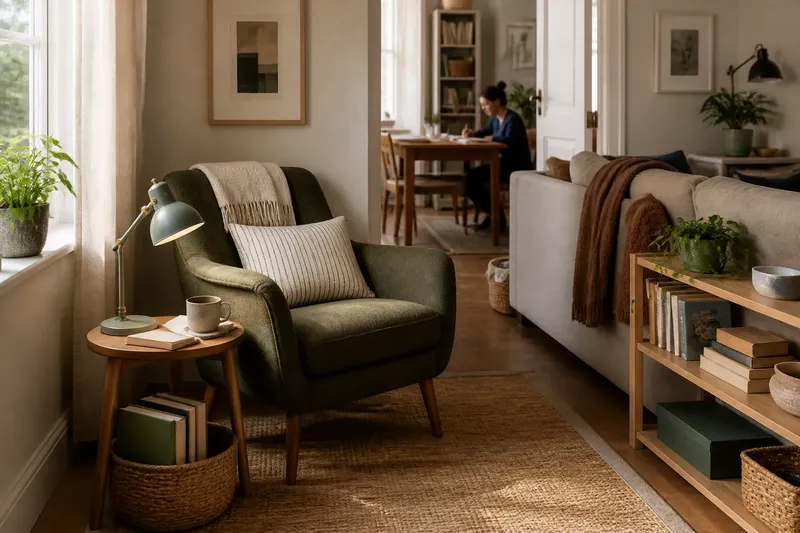
Where can a reading nook in a shared room go so you can concentrate without shutting everyone else out? Start by watching how people already move through the room. A chair beside a clear wall may suit a quiet corner; the same chair beside a doorway can become an obstacle and a constant interruption.
The aim is not to build a miniature room. It is to give reading a recognisable place within a room that still has other jobs. Position, orientation, modest boundaries and useful items within reach can do that without a fixed partition. The best arrangement depends on what the room is shared for, what kind of interruptions are likely and how much space can remain available to others.
Read the room’s routines
Before moving furniture, notice the routes people take and the places they pause. In a living room, traffic may run between the entrance, sofa and kitchen. In a bedroom shared with a desk or play area, movement may be less regular but the room’s surfaces and storage are already in demand.
Look for repeated patterns rather than imagining an idealised quiet room. Where do bags land? Which surface is needed for a shared activity? Does someone often cross the room to reach a window, wardrobe or charging point? A nook that occupies a route or claims a needed surface may look tidy while making ordinary use harder.
Mark a possible footprint with a folded blanket or a few books placed on the floor, keeping the route visibly open. Then consider the chair, a small place for a book and any lamp or other essential. The arrangement should make sense as a group, not just as an attractive chair placed in isolation.
Match the position
Different rooms call for different placements. Choose by the main source of interruption and by whether the reader needs to watch, hear or ignore activity elsewhere.
- For a room with a clear wall: Place the seat near the wall and turn it slightly towards the room. This gives the reader a calmer view while preserving awareness of other people. It fits when the wall is not already needed for a screen, door swing or frequently used storage.
- For a room with a busy central route: Put the nook at the edge of the activity, away from the line between entrances and shared destinations. Turn the seat so the reader is not facing people as they pass. This suits rooms where interruptions are mainly visual and the perimeter has usable space.
- For a room where someone needs to supervise activity: Orient the seat towards the shared area rather than towards a wall. The reader can keep a relaxed view of the room and respond when needed. This is a better fit than a tucked-away corner if reading and supervision must happen together.
- For a room with a window: Try a position beside it rather than directly in front of it. Side light can make a page easier to read, while a seat facing the window may put bright light in the reader’s eyes or leave the book in shadow. Check the position at the time of day when the nook is most likely to be used.
- For a room with no spare corner: Use a seat already needed for another purpose, such as an armchair at the edge of a living area. Make the reading place legible through its orientation and a small, movable surface for a book. This works when adding another chair would crowd the room.
These are starting points, not fixed rules. Say you share a living room where one person often walks from the door to a table behind the sofa. You could try turning an existing armchair towards a blank wall beside the sofa and placing a small basket of current books at its side. The expected observable result is a seat that faces away from the main route, with the route still clear and the books close enough to retrieve without crossing the room.
Use light and sound
Orientation affects more than the view. It changes how light falls on the page and how much of the shared room reaches the reader. A seat turned away from a television may reduce visual distraction, but it does not block sound. If conversation is the main interruption, placing the nook farther from the busiest gathering point may help more than adding a decorative boundary.
Check both daylight and artificial light. A reading lamp can be useful if it is already available, but its position should not cast a strong shadow across the book or shine into another person’s eyes. In a shared room, a directional lamp is often less disruptive than lighting that brightens the whole space. Keep cords and the lamp’s base out of the route people use; where a suitable safe arrangement is unclear, follow the product instructions or ask a qualified professional.
Also notice what the reader hears from the chosen seat. A wall may soften the sense of activity by reducing the view, though it will not make a room soundproof. If the space serves as a work or conversation area, agree on a simple signal for reading time, such as turning the chair towards the wall. A visible, reversible cue can help others understand the intention without implying that the room is closed to them.
Make a light boundary
A boundary can suggest “this is where I read” without dividing the room. A rug can define the seat’s area, while a low side table or an existing bookcase can mark one edge. The useful boundary is one that is easy to move, does not obstruct sightlines where people need them and does not make the shared route feel narrower.
Think of it like a placemat on a shared table: it marks a person’s working area without claiming the whole surface. A small rug or side table can perform a similar role for the nook. The mark should remain modest. If the chair, table, rug and storage together make a dense island, the nook may feel more like an obstacle than an invitation.
Use what the room already contains before bringing in extra furniture. A cushion in a distinct colour, a basket of books or a movable footstool can give the seat a recognisable purpose. Avoid using a tall object as a screen if it blocks a window, a needed view across the room or access to shared storage. The boundary should help the reader settle while leaving other people able to use the space naturally.
Keep essentials reachable
A nook is easier to use if the reader can get comfortable without repeatedly leaving the seat. Keep only the items that support the activity close by: the current book, reading glasses, a bookmark or a place for a drink if the room and furniture allow it. A small basket can hold a few books without turning the nook into overflow storage.
Choose a surface that suits the chair and the way the reader holds a book. A side table is useful if it can sit beside the seat without jutting into a route. If there is no room, a sturdy basket or a shelf on an existing cabinet may work better. Keep the floor around the chair clear so someone can sit down, stand up and pass without negotiating a cluster of objects.
Shared essentials need a clear home. If the lamp, blanket or book basket also serves other people, choose a place where it can be returned without dismantling the nook. The point is not to reserve every nearby object for one reader. It is to make the reading setup easy to restore after the room has been used for something else.
Choose by room constraint
Some decisions are less about style than about the room’s competing demands. If a door opens into the proposed nook, move the chair beyond its swing rather than asking people to squeeze past. If a radiator, vent or frequently opened window sits nearby, avoid placing fabric or furniture where it interferes with access or airflow. Follow the relevant product guidance and local requirements where they apply.
In a narrow room, prefer a compact chair already in use elsewhere over a deep lounge seat that consumes the only open route. In a room with children or pets, consider whether a low table or loose floor cushion is likely to be moved during normal play. In a room shared by people who need different levels of quiet, a position at the edge of activity may be more realistic than the deepest corner, especially if the reader can shift the chair when the room changes purpose.
When the room’s use changes through the day, make the nook temporary by design. A lightweight basket and a chair that can turn or move are easier to adapt than a heavy arrangement built around one fixed spot. That flexibility matters if the same area must become a workspace, play area or clear floor later.
Questions about placement?
Should the chair face the wall or the room?
Face it towards a wall when visual activity is the main distraction and the reader does not need to watch the shared area. Face it towards the room when supervision or awareness matters; a slight turn can soften the view of traffic without cutting the reader off.
Can a nook fit in a small living room?
Yes, if it uses a seat and surface the room can already accommodate. A chair at the edge of the shared area, turned away from the main route, may define a reading place without adding a separate furniture group.
What can mark the nook without a partition?
Try orientation, a small rug, a basket of books or a side table that stays clear of the route. These cues can make the spot recognisable while remaining movable and allowing the room to serve its other purposes.
How can the nook feel quieter?
Place it away from the busiest path and turn the reader’s view from the main activity. If sound is the greater problem, a boundary will not remove it; agree on a quiet period or choose a time when the room is less active.
Review the arrangement
After choosing a position, use the room as usual and notice what becomes awkward. Does someone detour around the chair? Is the book hard to reach? Does the reader face glare, or does the nook claim a surface everyone needs? Make one adjustment at a time, such as turning the seat or moving the basket, so the reason for each change stays clear.
A reading nook in a shared room works best when it gives the reader a settled orientation without making a claim on the whole space. For the first trial, keep the arrangement simple: one seat, a clear route, a modest boundary and essentials within reach. If the room’s routines still flow, the nook is doing its job.